Laser hair removal on dark skin: what you should know
By the Ice Laser team · · 3 min read
Contents
For a long time, the rule was: laser hair removal only for fair skin and dark hair. People with a darker complexion – for example with Turkish, Arab, South Asian or African roots – were often told the treatment was too risky. That is no longer true today. With the right wavelength and experience, dark skin can be treated safely too. Here we explain what matters.
In short: Dark skin can be treated with a laser when a wavelength is used that is absorbed less strongly by the skin’s pigment – above all Nd:YAG at 1064 nm. The Soprano Titanium has this wavelength built in. A trial treatment, adjusted settings and patience are important: often one or two extra sessions are needed.
Why dark skin is a particular challenge
The laser targets the pigment melanin in the hair. But dark skin itself contains a lot of melanin. With an unsuitable wavelength, it is not only the hair but also the skin that absorbs energy – which can lead to burns or pigment changes (light or dark patches). Specialists therefore classify skin type on the Fitzpatrick scale from I (very fair) to VI (very dark) and choose the wavelength and energy accordingly.
Which wavelength for which skin type?
| Wavelength | Strength | Suitable for |
|---|---|---|
| 755 nm (alexandrite) | Strongly absorbed by melanin | Fair skin (types I–III), also for finer hair |
| 810 nm (diode) | Balanced | Fair to medium skin (types I–IV) |
| 1064 nm (Nd:YAG) | Penetrates deeply, absorbed less by skin pigment | Dark skin (types IV–VI) and deep-rooted hair |
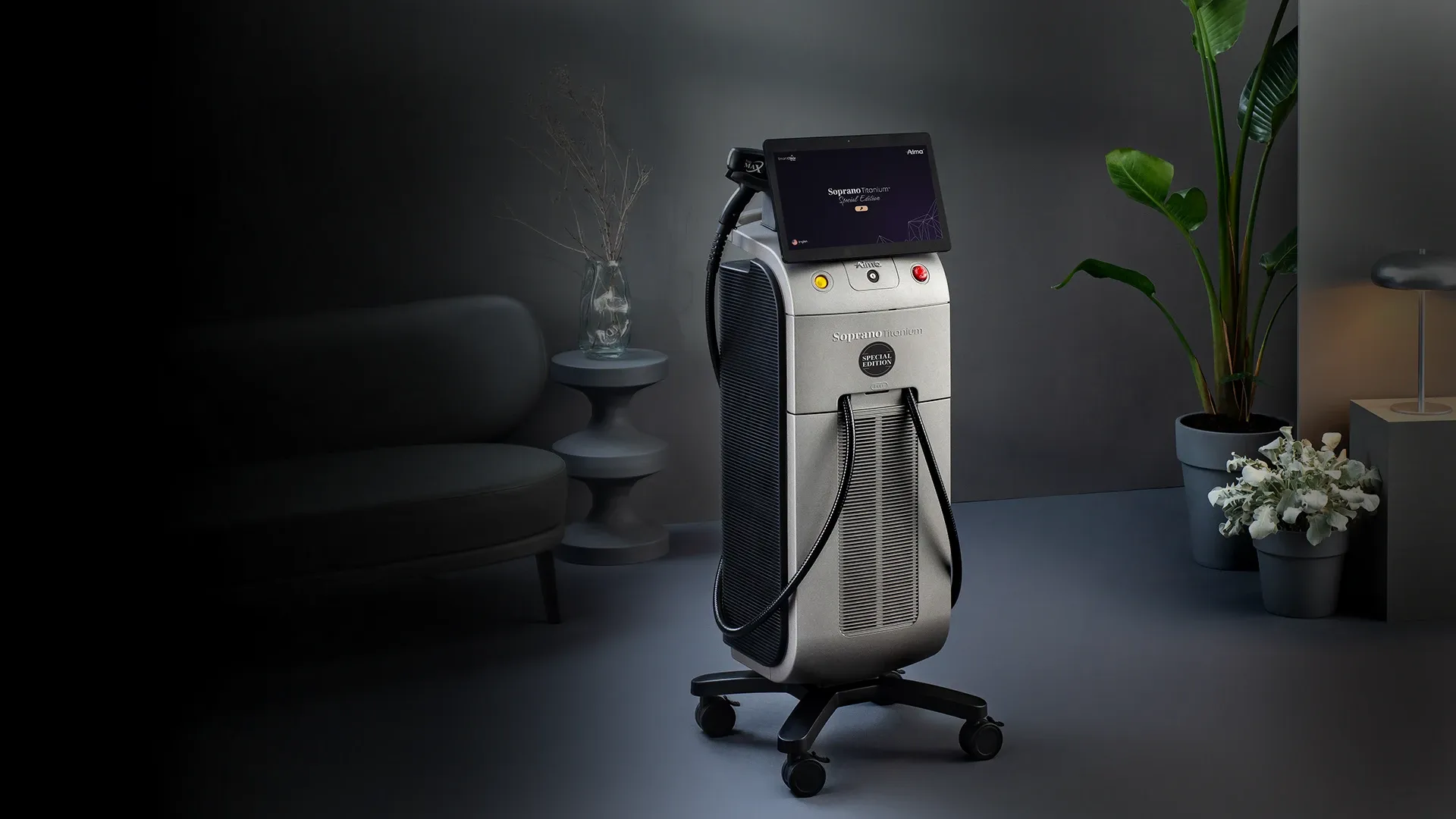
The Soprano Titanium combines all three wavelengths in one handpiece. For dark skin, the Nd:YAG component is what matters most. On top of that, the skin surface is cooled, which gives the skin additional protection.
What is different with dark skin
- The trial treatment is a must, not an extra: We first treat a small, discreet spot and check the reaction before the whole area is treated.
- A cautious start: The energy is set rather lower at first and adjusted from session to session.
- More patience: Because we work more gently, 8 to 10 sessions instead of 6 to 8 are often needed.
- The sun is the biggest enemy: Freshly tanned skin significantly increases the risk of pigment patches. Before and during the course of treatment: no sunbathing, no sunbeds, sun protection SPF 50+.
- Good news: With dark skin, the hair is usually dark and coarse as well – which makes it easy for the laser to reach.
Possible side effects
Redness and slight swelling around the hair roots for a few hours are normal. With dark skin, temporary dark patches (hyperpigmentation) can occasionally appear; these usually fade within a few weeks. In rare cases, the laser can stimulate fine hairs on the face, neck or shoulders to grow instead of reducing them (paradoxical hypertrichosis). This risk is slightly higher with dark skin – we discuss it openly beforehand.
Frequently asked questions
Is IPL an alternative for dark skin?
Not really. IPL works with a broad light spectrum that also heats pigment-rich skin strongly. Most IPL devices – including those for home use – are explicitly not approved for dark skin types.
Can my face be treated too?
Yes, for example the upper lip, chin or beard line. On the face in particular, we work especially carefully with dark skin. Find out more on our page about facial hair removal.
Does the treatment cost more for dark skin?
No, the price per session is the same – for example €40 for the underarms. However, one or two extra sessions may be needed. You can find all prices in our price list.
Would you like to know how your skin reacts? We will find out together at the free trial treatment in Cologne-Rondorf or Düsseldorf city centre. Book your appointment now.